
Spanish courses vs. learning apps - pros and cons for you
 • February, 24 2026

So you’ve decided to learn Spanish? Nice. That’s a promising first step, with Spanish on such a spectacular curve and arguably the coolest language in the world. But now you’ve got to figure out how to learn it. These days, that isn’t so simple. There are so many ways to go.
The options really are bewildering - you could even partner-up with a chatbot to simulate conversations with an authentic local - but in this article, we’re going to focus on two of the most common routes: taking a structured course, or using an app. We’ll look at the advantages and disadvantages of each approach and consider how the two routes can be blended. We’ll recommend the best choice, depending on your situation.
Structured Spanish Courses: overview
First stop, the good ol’ approach of taking a course under the stewardship of a teacher. These courses can be studied within a school, like ours in Barcelona, but you can also find courses that are purely online. Any decent course should follow a curriculum that’s designed to guide learners through a framework of beginner to advanced levels (A1-C2 in Spanish).
Advantages of Structured Spanish Courses
- Organized syllabus: Gain a well-rounded foundation that balances grammar, vocabulary, conversational fluency, and writing skills.
- Guided by professionals: Benefit from the expertise of human educators who know their stuff inside out.
- Tailored corrections: Receive personalized feedback to fix bad habits early and refine your technique.
- Collaborative environment: Enjoy practicing to speak in a natural way, with other folk at a similar level. Some of these people will also become friends.
- Clear milestones: Stay motivated by working toward goals and advancing through measurable proficiency levels.
- Accreditation: Spanish courses are guided towards receiving formal accreditations through exams.
- Cultural immersion: The best Spanish courses, such as those offered by ILA, include cultural activities as part of the process - so you can bring your learning into the real world. For instance, at ILA we take students on a visit to the market to put foodie vocab into play.

Disadvantages of Structured Spanish Courses
- Rigid scheduling: Demands adherence to fixed class times, offering less adaptability for unpredictable or busy routines.
- Larger Investment: Typically requires a loftier budget compared to self-taught methods or subscription-based mobile apps.
- Restricted pacing: Your progression is dictated by the syllabus and the class average, meaning you can't speed ahead or slow down based on your individual needs.
- Location: The best Spanish courses are often those within Spanish-speaking countries, like Spain. There will be limited options available if you’re not prepared to travel.
Self-Paced Spanish Apps: overview
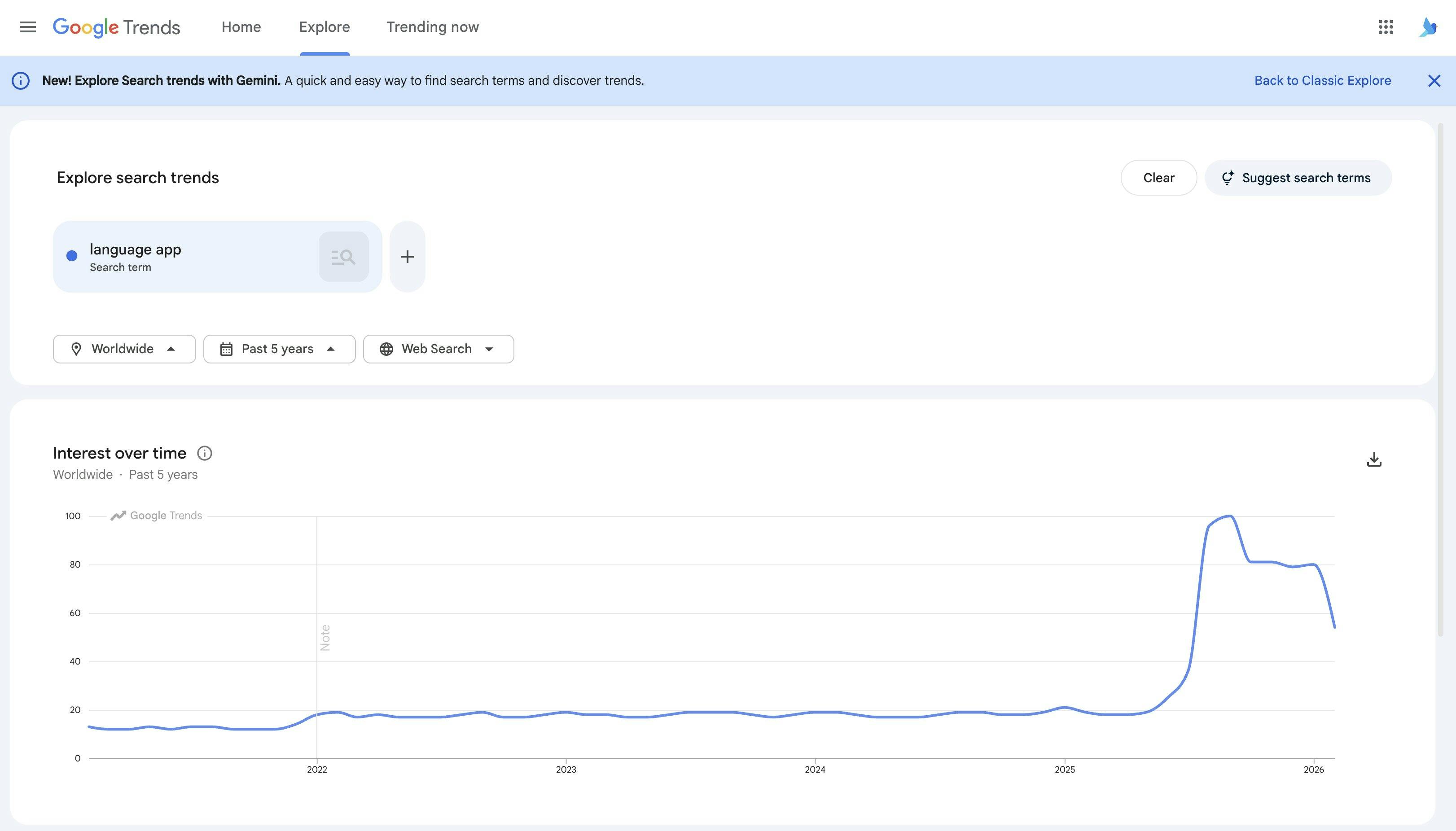
There are apps for everything these days - and demand for language apps is soaring. Popular apps such as Duolingo, Babbel, or Pimsleur, allow folk to learn Spanish anytime, anywhere, at their own pace. These impressive applications use games, flashcards, and interactive exercises to teach vocabulary and grammar. Increasingly, they’re integrating AI to simulate real-world activities like conversational practice.
Advantages of Self-Paced Spanish Apps
- Total flexibility: Study completely on your own schedule and dictate your own pace.
- Cost effective: Enjoy lower financial barriers, as most platforms offer free tiers or inexpensive subscriptions. Even Duolingo’s fanciest tier - including the latest AI innovations - only costs around $30 per month.
- Gamified approach: Interactive exercises, like fun quizzes, and reward systems, are great at keeping you engaged vs. tedious rote learning from a textbook.
- Bite-sized sessions: Fit language practice easily into a busy day with short, highly convenient lessons.
- Beginner friendly: Build a foundational understanding intuitively, making it a perfect starting point.
Disadvantages of Self-Paced Spanish Apps
- Isolated practice: You will miss out on the dynamic, real-time conversational experience you get with a fellow human.
- Missing feedback: Apps lack the personalized guidance, nuance, and specific corrections that a qualified teacher provides.
- Predictable loops: Risk losing motivation as exercises and content can become repetitive and mechanical over time.
- Screen time: When people are increasingly aiming to spend less screen time - a language app binds you to more, not less.
- Accreditation: If you’re looking for a formal accreditation - instead of a fun yet meaningless online trophy - then an app isn’t going to be thorough or directed enough to get you what you need.
- Misleading progression: Without the context of a formal, leveled curriculum, it’s a struggle to measure true fluency. You may know that person who has spent ages on an app, and achieved a ‘level’ implying high fluency, only to be barely able to speak a coherent phrase of the language in a real life conversation.
All considered: Spanish App vs. Course
Considering those pros and cons, let’s compare the two methods across some key areas to help you choose whether to use an app or course to learn Spanish.
- Practice: Structured courses immerse you in real, dynamic conversations with guided speaking exercises. Apps generally offer only limited, simulated dialogue, and while AI is improving this offering it’s still way short.
- Flexibility: Apps give you the liberty to learn whenever and wherever it suits you, while structured courses require you to adhere to a fixed class schedule.
- Cost: Formal courses typically require a larger financial investment, whereas mobile applications are accessible for free or for a small monthly investment.
- Feedback: Live classes offer nuanced, expert corrections tailored to your mistakes, while self-paced platforms rely entirely on basic, automated grading.
- Engagement: Traditional classes keep you motivated through active participation and live peer discussions, whereas digital tools rely on gamification, rewards, and interactive quizzes to hold your attention.
- Culture: Good courses immerse you in the local culture, as well as teach you through a curriculum. You’ll be living the language - not just learning it. This is a major weakness of apps, which struggle to offer anything in this regard.
But it’s also about you. What’s best depends on your learning style, goals, time and commitment. Here’s a guide to help you decide:
Choose a Structured Spanish Course if:
✅ You want guidance from a human teacher.
✅ You prefer the structure and reliability of a syllabus.
✅ You aim for fluency, or a decent level - not just some basics.
✅ You prefer learning in a classroom with other people.
✅ You are seeking a certification or professional development.
✅ You value new life experiences and friendships.
Choose a Self-Paced Spanish App if:
✅ You prefer to work within your own loose schedule.
✅ You don’t want to commit any serious budget to the task.
✅ You are just curious about the language, for fun.
✅ You would like to supplement your other learning methods.
✅ You enjoy the endorphin rush of digital gamification.
✅ You care not about spending more time glued to a screen.
Why not combine both methods?
Like most arguments - the wisest answer isn’t arrived at from pitting one side against the other; good versus bad. The most sensible approach can be the best of both worlds.
Here in Barcelona, we’ve found that when students combine structured courses with self-paced apps, it can accelerate learning. Some of our teachers also employ apps for fun exercises from time to time.
How to create a hybrid learning strategy
- Enroll in a course: Build the core of your Spanish skills with structured lessons and expert instruction.
- Dip-into apps for daily drills: Use self-paced tools to maintain consistency and quickly expand your vocabulary on the go.
- Find an ‘intercambio’ partner: Step outside the classroom to practice spontaneous speaking and build real-world confidence.
- Immerse yourself in media: Embrace Spanish TV shows, movies, and podcasts to train your ear to native pacing and accents.
- Maintain a language journal: Practice your writing skills and reinforce new grammar by documenting your daily thoughts in Spanish.
Example daily study plan - for our students in Barcelona

- Morning: Take the metro to our nearest stop, Verdaguer - or the Sicilia tram stop right outside the school. It’s an opportune moment to spend 15 minutes on a language app for a gamified vocabulary boost.
- Afternoon: Attend an in-person Spanish course at our lovely, modern, friendly school: Iberia Language Academy in Barcelona - set in the shadow of the Sagrada Familia.
- Late Afternoon: Meet up with intercambio partner for Spanish practice at Bloome on nearby Passeij de Sant Joan (good choice, delicious coffee).
- Evening: Unwind by watching the news in Spanish, catching up on the day’s events and simultaneously improving your listening skills.
By mixing both formal instruction and other methods, like mobile apps, you give your language skills some help to get to the next level sooner.
A real attempt at fluency or just a dabble?
Ultimately, whether you use an app or take a course is about your objectives. If you’re serious about learning Spanish then all considered you should take a course - and ideally an intensive Spanish course. That doesn’t mean you shouldn’t use apps to boost your learning as part of a holistic plan.
On the other hand, if you’re just dabbling in the language for some fun then apps can be an absolutely brilliant introduction. A course is a lot of commitment and it’s not for everyone. After all, you could always start with an app and then get a course booked later once you’re ready to commit.
Get your Spanish learning journey started
If you’re ready to take the plunge now and go ahead with a fully-fledged Spanish course - filled with structured lessons and eye-opening cultural immersion - then why not consider our Spanish courses in Barcelona? Combine that with a supplementary boost from an app and you’ll be chirping in Español like a local sooner than you’d think.
Popular Posts
The benefits of cultural immersion when learning Spanish in Barcelona

Barcelona or Madrid to learn Spanish, which city is the best?

Spanish courses vs. learning apps - pros and cons for you
Is Barcelona a good place to learn Spanish?


Subscribe To Our Mailing List!
Receive course updates, graduate reviews, exclusive discounts and more